Tamper Proof Rat Bait Station
Tamper Proof Bait Station 3

Tamper-Proof Rat Bait Stations – The Smart, Safe, Permanent Barrier Against Rats

The single most effective way to stop rats before they ever get inside your home, office, restaurant, factory, or complex is to intercept them on the outside with professional-grade, tamper-proof bait stations.

Why exterior bait stations work so well

Rats live and breed outside first. They only move indoors when food, water, and shelter become easier inside than outside.
By placing locked bait stations around the perimeter of your property, we:

  • Attract rats to feed in the stations before they come inside, and chew your wiring, contaminate your kitchen, or breed in your ceiling.
  • Dramatically reduce the outdoor population (the “reservoir” that keeps re-infesting the building).
  • Create a permanent barrier that new rats walking in from neighbouring properties encounter immediately.
  • Keeps bait away from non-target species ie. pets etc.

Two types of heavy-duty, weather-proof stations we use

  1. Wall-Mounted Tamper-Proof Boxes
  • Black plastic boxes.
  • Securely bolted or cable-tied to exterior walls, fence posts, down-pipes, or palisade fencing every 10–15 metres apart.
  • Ideal for homes, complexes, warehouses, and food premises.
  1. Landscape “Stealth” Stations
  • Disguised as rocks.
  • Spiked or pegged firmly into flower beds.
  • Perfect for upmarket estates and properties where aesthetics matter.

Both types are:

  • 100 % locked with a special key (only SWAT technicians can open them)
  • Fully weather-proof – bait stays dry even in heavy rain
  • Child- and pet-safe (even if a dog manages to pull one loose, they cannot access the bait)
  • Fitted with vertical bait rods or trays that only rodents can reach

Inside the boxes – latest-generation baits rats cannot resist

We use only registered, high-potency anticoagulants rodenticides
Rats need to eat only a few grams , then die within 3–7 days – usually outside in the garden or storm-water system.

Additional benefits of a perimeter bait-station programme

  • Minimising the risk of rats dying inside or in the ceilings.
  • Fully compliant with health & safety audits (restaurants, hotels, schools, and factories).
  • Protects your vehicles parked in the driveway (rats will be attracted to the bait).
  • Long-term cost saving – one annual contract is cheaper than repeated call-outs .

How the SWAT Perimeter Defence System works

  1. Free quotation
  2. Installation of the correct number of stations for your property size and risk
  3. Monthly, 6-weekly or quarterly service visits (we check, re-bait, and remove any old bait)

Contact SWAT today for your no-obligation perimeter bait-station quote.

Landscape Rat Station
Fleas
Flea
Fleas – Tiny but Extremely Dangerous Pests!
Fleas are small, wingless, dark-brown or reddish-black insects measuring only 1.5–3.3 mm long (about the size of a pinhead), yet they are one of the most irritating and potentially harmful pests found in homes, especially those with pets.
General biology and appearance
Flattened sideways bodies allow them to move easily through fur, hair, carpets, and clothing
Enormous hind legs give them incredible jumping power – up to 35 cm vertically and 20 cm horizontally (200 times their body length)
Hard, shiny bodies make them difficult to crush
Piercing-sucking mouthparts designed to cut through skin and feed on blood
Adults can live 2–3 months (sometimes longer) under ideal conditions, feeding every few days
In South Africa the most common species in homes is the cat flea (Ctenocephalides felis) – it happily bites dogs, cats, humans, rats, and wildlife. Dog fleas, bird fleas, and the human flea (Pulex irritans) are also encountered.
The flea life cycle – why they come back again and again
Only 5 % of the infestation is adult fleas you can see jumping. The other 95 % are eggs, larvae, and pupae hidden in the environment.
Eggs
After a blood meal, a female can lay 20–50 eggs per day (up to 2,000 in her lifetime). Eggs are white, oval, and tiny; they fall off the host into carpets, pet bedding, cracks in wooden floors, under furniture, and garden soil.
Larvae
Worm-like, creamy-white larvae hatch in 2–14 days. They avoid light and feed on organic debris and dried blood droppings from adult fleas. They thrive in warm, humid conditions.
Pupae (the hidden danger)
After 1–2 weeks the larva spins a sticky silk cocoon camouflaged with dust and debris. Inside, it turns into a pre-emergent adult.
These pupae are almost indestructible – vacuuming, insecticides, and even freezing often fail to kill them.
Pre-emergent adults can remain dormant inside the cocoon for up to 6–12 months waiting for the right trigger.
Emergence trigger
Vibrations (footsteps), heat, pressure, and carbon dioxide from a potential host cause hundreds of hungry adult fleas to burst out of their cocoons simultaneously.
This is why people returning to a vacant holiday home or moving furniture after months can suddenly be covered in biting fleas within minutes – the “flea bomb” effect.
Health risks and irritation
Bites usually appear as small red spots with a central puncture, often in clusters or lines around ankles, legs, and waist
Intense itching leads to scratching and secondary bacterial infections (especially in children)
Some people and pets develop flea-allergy dermatitis (FAD) – severe skin inflammation from flea saliva
Fleas are vectors for diseases:
Plague (rare but still present in some wildlife cycles)
Murine typhus
Cat-scratch disease (Bartonella)
Tapeworm transmission (if a child or dog swallows an infected flea)
Where fleas hide in the home
Deep in carpets and rugs
Pet bedding and baskets
Under furniture, skirting boards, and in cracks in wooden or laminate floors
Upholstered furniture and mattresses
Vehicles (if pets travel in the car)
Garden soil, sandpits, and under decks where animals rest
Why DIY treatments usually fail
Supermarket flea bombs and pet sprays only kill adult fleas on the day of treatment. Eggs and pupae survive, and within weeks the population rebounds – often worse than before because the vacuuming that should accompany treatment is skipped.
Professional flea control that actually works requires a coordinated attack on every life stage:
Treat all pets with vet-approved products (spot-ons, tablets, or sprays)
Hot-wash pet bedding
Thorough vacuuming and empty the bag afterwards
Professional application of an insect growth regulator (IGR) plus residual insecticide throughout the house or vehicle
The residual chemical will kill newly emerged adults on contact
If you’re being eaten alive by tiny jumping insects, your pets are scratching non-stop, or you’ve just opened a holiday home and been attacked by fleas, don’t suffer another day.
Call SWAT Exterminators for a fast, guaranteed flea eradication programme that breaks the cycle completely. Get back to enjoying your home – without the itch!
Flea Lifecycle
Flea Lifecycle
Cockroach German
Cockroach German
Cockroach German

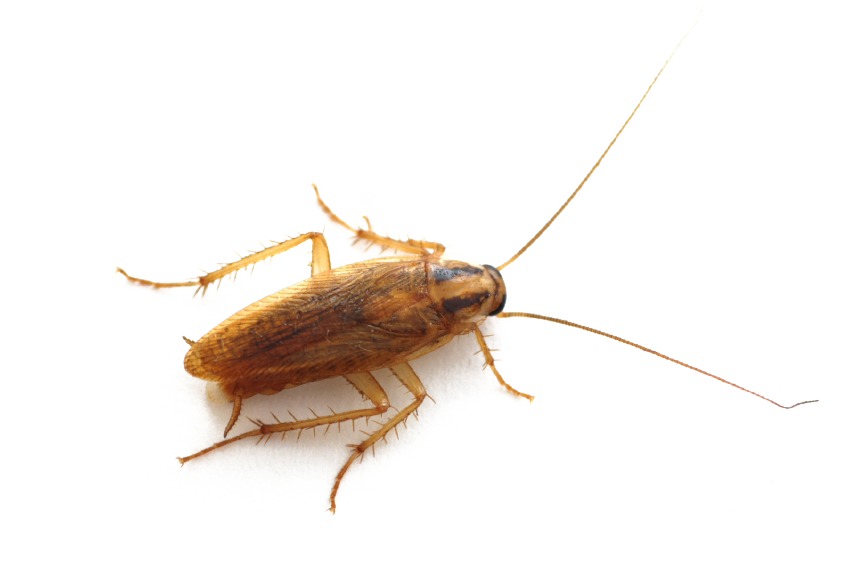
German Cockroach (Blattella germanica)

Probably the most invasive and troublesome cockroach species found in homes, restaurants, hospitals, hotels, supermarkets, food-processing plants, and virtually any building where people live or handle food.

Appearance

Adults are light tan to medium reddish-brown with two distinctive, almost black parallel stripes running lengthwise from the back of the head down the pronotum (the shield-like area behind the head). These two dark bands are the quickest way to identify them. They are relatively small—adults reach only about 13–16 mm long (roughly half an inch)—making them more discreet and harder to spot than larger species like American or Oriental cockroaches. Both males and females have wings that cover the abdomen, but they rarely fly; they prefer running at high speed.

Life cycle and reproduction – the reason they explode in numbers so quickly

The German cockroach has one of the fastest reproductive rates of any household insect:

  • A single mated female can produce 300–400 offspring in her lifetime.
  • Females carry the egg capsule (ootheca) protruding from the tip of the abdomen for 20–30 days until just hours before the eggs hatch.
  • Each light-brown capsule is 7–9 mm long and contains 30–40 eggs (sometimes up to 48).
  • Nymphs hatch inside the home and go through 6–7 moults over 6–12 weeks before becoming adults (faster in warm, humid conditions).
  • Under ideal kitchen conditions (28–32 °C), a population can increase from a single pregnant female to many thousands in less than six months.

Because the female protects the egg case almost until hatching (unlike most roaches that drop or glue it somewhere early), very few eggs are wasted, giving this species a huge survival advantage indoors.

Where they live and hide

German cockroaches have evolved to live in very close association with humans and cannot survive outdoors in temperate climates. They need warmth (below 15 °C they stop breeding), moisture, and food. Favourite locations include:

  • Behind and under kitchen appliances (fridges, freezers, stoves, dishwashers, microwaves)
  • Inside motor compartments of fridges and vending machines
  • Cracks around cupboards, kick plates, and pipework
  • Behind loose tiles, wallpaper, and electrical sockets
  • In bathrooms around sinks, toilets, and hot-water pipes
  • Inside false ceilings, wall voids, and drawer slides
  • In commercial kitchens: under stainless-steel benching, inside grease traps, and around drains

They will spread throughout an entire building via pipe chases, electrical conduits, and shared walls in apartments and hotels.

Health risks and contamination

German cockroaches are not just unpleasant—they are a serious public-health pest:

  • They carry and spread bacteria such as Salmonella, E. coli, Staphylococcus, and Streptococcus on their bodies and in their faeces.
  • They contaminate food, utensils, and surfaces with pathogens and allergens.
  • Cockroach droppings, shed skins, and saliva contain potent allergens that are a major trigger for asthma, especially in children. Studies show that 80–90 % of inner-city children with asthma are sensitised to cockroach allergens.
  • Their faecal pellets (small, dark, ink-spot-like specks) and musty odour are often the first signs of an infestation.

Signs of a German cockroach infestation

  • Live nymphs or adults seen in daylight (a sign the population is large and overcrowded)
  • Pepper-like black droppings in drawers, on shelves, or along edges
  • Egg capsules (empty or full) dropped in hidden corners
  • A distinctive sweetish, oily odour in heavy infestations

Why they are so hard to control

  • Extremely high reproductive rate
  • Rapid development of insecticide resistance (many populations are now resistant to pyrethroids, carbamates, and even some organophosphates)
  • Preference for hiding in tiny cracks that sprays can’t reach
  • Ability to survive on minuscule amounts of food (hair, glue, soap residue, toothpaste)

Effective control almost always requires a professional integrated approach using insect growth regulators (IGRs), non-repellent residual insecticides, and high-quality gel baits applied precisely into cracks and crevices. DIY efforts with supermarket sprays and foggers usually make the problem worse by scattering the population and accelerating resistance.

If you see even one German cockroach during the day, it’s a warning that hundreds or thousands are hiding nearby. Call SWAT Exterminators immediately for a thorough inspection and targeted treatment programme.

Don’t share your home with the world’s most unwanted housemate.

Weeds
Weed Control
Weed Control

Professional Weed Control – Beautiful Lawns, Clean Driveways, and Safe Electric Fences

Tired of ugly broad-leaf weeds ruining your perfect Kikuyu, LM, or Buffalo lawn? Sick of grass and khakibos growing between bricks, stones, or along your electric fence?
SWAT Exterminators and Weed Control gives you fast, long-lasting, weed-free results without harming your grass or pets when done correctly.

What we treat

  1. Lawns – Selective eradication of broad-leaf weeds
    ( khakibos, blackjacks, thistles, dandelions, cape weed, etc.) while keeping your lawn 100 % green and healthy.
  2. Paved & brick areas – Total weed kill
    Driveways, walkways, patios, parking lots, and cobblestone areas stripped clean of grass, weeds
  3. Electric fence lines & perimeter strips
    A neat 500 mm–1 m weed-free zone along boundary walls and fences so your electric fence stays effective and visible (no more grass shorting out the wires).

How we do it – safe and super-effective

  • We use only registered professional-grade herbicides
  • Lawns: Hormone-type selective sprays that kill broad-leaf weeds right down to the root but are completely harmless to all grass species
  • Hard surfaces : Systemic + contact or residual herbicides that prevent regrowth for 6–12 months
  • Spot treatment or blanket application depending on the area
  • Rain-fast within 1–2 hours

Results you’ll see

  • Broad-leaf weeds in lawns start curling and yellowing within 7 – 14 days, dead in+- 3 weeks, in some cases a second spray is nesessary after 2 weeks
  • Paving and fence-line weeds turn brown and stay gone for months
  • No brown patches in your grass – only thick, green, weed-free lawn

Why choose SWAT

  • Fully trained and licensed applicators
  • Pet- and child-safe once dry (usually 2–4 hours)
  • Free re-treatment if weeds return within guaratantee period
  • Once-a-year or bi-annual maintenance contracts available at big savings

Stop pulling weeds by hand or wasting money on weak supermarket products that only burn the tops.

Call or WhatsApp SWAT Exterminators and Weed Control today for your free quote and get the neat, clean, professional look you deserve
Your lawn, driveway, and fence will thank you!

Termites
Termite Soldiers and Workers

Termites – The Silent Destroyers (Also Known as White Ants)

Termites are often mistakenly called “white ants,” but they are not ants at all – they are highly organised, wood-eating insects that have been on earth for over 120 million years. In South Africa we have more than 20 species, but the most destructive to homes are the subterranean termites

A single colony can contain anything from 100,000 to over 2 million individuals and consume up to 15 kg of timber per year. They never sleep, never stop eating, and can collapse an entire roof structure without any visible warning from the outside.

How termites enter ANY home – brick, stone, or steel

Termites do not need big holes. They exploit the tiniest weaknesses:

  • Cracks in foundations and slabs
  • Expansion joints and construction joints
  • Gaps around water pipes, electrical conduits, and sewer lines
  • Weep holes that have lost their mesh
  • Behind retaining walls and garden beds built against the house
  • Through cavities in double-brick walls or under dry-wall partitioning
  • Up the inside of exterior walls using mud shelter tubes hidden behind skirting or plaster

Because they avoid light and work from the inside out, damage is usually extensive by the time it is noticed.

The one time you WILL see them: Swarmers (incorrectly called “flying ants”)

Defference Between Termite Swarmer and Ant Swarmer

On warm, humid evenings after the first summer rains (usually October–March in KZN ), mature colonies release hundreds or thousands of reproductive termite swarmers (alates).
These winged adults are dark brown to black, 10–14 mm long, and swarm at dusk, often attracted to lights. After a short flight they shed their wings (you’ll find piles of discarded wings on window sills, floors,

Finding swarmers or wings inside the house is a red-flag emergency if your windows are closed – it means therecould be an active colony directly under your building.

How to tell a Termite Swarmer from a real Flying Ant (side-by-side comparison)

FeatureTermite SwarmerFlying Ant
AntennaeStraight, bead-likeElbowed (bent)
WaistThick, no obvious waistPinched, narrow waist
WingsFour wings all same lengthFront wings longer than back
ColourDark brown to blackOften reddish or black

If in doubt, collect a few in a jar and send us a photo – we’ll identify them instantly.

Classic signs of hidden termite activity

  1. Mud shelter tubes (sometimes as thin as a pencil) running up foundation walls, inside cupboards, or across brickwork
  2. Hollow-sounding timber when tapped – skirting boards, door frames, window sills, roof trusses
  3. Ripples, blisters, or sinking in painted surfaces (the termites eat the wood but leave the paint layer)
  4. Sudden buckling of hardwood floors or sagging ceilings with no visible water damage
Termite Mud Tubes
Termite Mud Tubes
Termite Swarmers incorrectly known as Flying Ants

We cover Pietermaritzburg, Howick, Hilton, Midlands, Mooi River, Nottingham Road, Boston, and the entire KZN Midlands.

Don’t wait for the roof to sag or the floor to collapse. If you’ve seen swarmers, wings, mud tubes, or have any suspicious hollow-sounding wood, contact SWAT Exterminators immediately for a professional termite inspection

One call today can save your home tomorrow. Phone or WhatsApp us now – we’re here to protect your biggest investment from the silent white army.

Termite Queen

Termite Queen

Opening to Termite Nest

Termite Hole
Soil Poison

Pre-Construction Termite Soil Barrier – Your Home’s Invisible 5-Year Shield Against Termites

Protect your new home, extension, or renovation from the very first day with a professional pre-construction termite barrier. This essential treatment stops subterranean termites (commonly called White Ants) before they ever reach your timber skirting boards, door frames, built-in cupboards, roof trusses, or flooring.

Why a pre-construction barrier is the smartest investment you’ll make

Termites cause more than R2 billion in damage across South Africa every year. In coastal areas like KwaZulu-Natal, termites are active year-round and can destroy a home silently from the ground up.
Once your concrete slab is poured, it is far more expensive to treat afterwards.

  • 100 % effective when done correctly
  • Up to 80 % cheaper than fixing termite damage later
  • Required by most banks for new bond approvals
  • Gives you a full 5-year transferable guarantee that adds real value when you sell

How the pre-construction termite barrier works

  1. Site preparation
    After foundations are dug and all fill material is levelled, but before any plastic, mesh, or concrete is laid.
  2. Professional application
    Our registered technicians spray the entire soil surface with a premium, long-lasting termiticide.
    We use only registered and approved products
  3. Creating the chemical shield
    The termiticide soaks into the top layer of soil and binds tightly, forming a continuous horizontal barrier that termites cannot cross without dying.
    Any termite that tries to tunnel up through the treated zone will pick up the chemical and carried it back to the nest thus killing of the entire colony – protecting your home for years.
  4. What you receive
  • Full treatment of the entire slab area
  • Official Pre-Construction Termite Treatment Certificate (required by NHBRC and bond registrars)
  • 5-Year Guarantee Certificate (registered and transferable to new owners)
  • Peace of mind that your biggest investment is safe from silent destruction

Why only a professional company can be trusted

  • Correct dosage and even coverage are critical
  • We use calibrated professional spray equipment (not garden sprayers) for perfect distribution
  • All technicians are registered with the Department of Agriculture (Act 36 of 1947)
  • Full public-liability insurance and compliance with health & safety regulations
  • We coordinate perfectly with your builder – we arrive on the exact day the soil is ready

Builders, homeowners, and project managers love working with SWAT because we turn up on time, finish fast , and leave the site spotless and ready for the slab pour the same day.

Don’t gamble with termites. One quick treatment now saves you hundreds or thousands in repairs later.

Call or WhatsApp SWAT Exterminators today to book your pre-construction termite barrier.

Build smart – build termite-proof from the ground up!

Rats
Rodent Control
Rodent Control

Rats – The Silent, Costly, and Dangerous Invader in Your Home and Car

South Africa is currently experiencing a massive surge in rat activity, and they’re no longer just a problem in the ceiling – they’re destroying cars, burning down houses, and spreading serious diseases.

Why rats simply cannot stop chewing

A rat’s front incisors never stop growing – up to 12–15 cm per year! Like our fingernails, they must constantly gnaw on hard objects to grind them down. If they don’t, the teeth grow through the jaw or curl into the skull.
In nature they chew wood and seeds. In your home and vehicle they chew:

  • Electrical wiring (causing short-circuits and house fires)
  • Water pipes and geyser overflow pipes (flood damage)
  • Insulation, wooden beams, and furniture
  • Car wiring looms, hoses, and plastic components

The new #1 reason your car is being destroyed: Eco-friendly, soy-based wiring

Until a few years ago, the plastic insulation on automotive and household wiring contained mineral oil or petrolium based derivatives that rats disliked.
Now, in an effort to be environmentally friendly, most major manufacturers have switched to soybean- and corn-based bio-plastics.
Rats absolutely love the taste and smell – they treat modern wiring like spaghetti!
One single rat can cause thousands in repairs (ECU damage, complete engine loom replacement). Insurance companies are paying out millions every month, and many policies now specifically exclude rodent damage or demand proof of professional treatment.

Explosive breeding – from 2 rats to 2,000 in a single year

  • Rats reach sexual maturity in just 8–12 weeks
  • Pregnancy lasts only 21–24 days
  • Average litter size: 6–12 babies
  • A female can have 5–10 litters per year

Under ideal conditions (food, water, shelter), a single pair starting in summer can produce over 2,000 descendants in 12 months. That’s why one or two rats quickly become a full-blown plague.

Serious health risks

Rats and their droppings contaminate everything they touch:

  • Leptospirosis (Weil’s disease) – from urine in water or damp soil
  • Salmonellosis – food poisoning from droppings on kitchen counters
  • Rat-bite fever
  • Hantavirus and plague (still present in some rural areas)
  • Allergies and asthma triggered by urine proteins in roof dust that falls into living areas

Their parasites (fleas, mites) can also transmit other diseases.

Common signs of rats in or around your property

  • Night-time scratching, squeaking, or scampering in the ceiling
  • Grease marks (rub marks) along skirting boards and beams
  • Small elongated droppings (12–18 mm, pointed ends) in cupboards or along runways
  • Gnaw marks on wood, plastic, or wiring
  • Burrows around compost heaps, under decks, or along exterior walls
  • Sudden car warning lights or total electrical failure

Professional control – the only long-term solution Effective rat management by SWAT includes:

  • Detailed inspection
  • Strategic placement of locked, tamper-resistant bait stations with latest-generation anticoagulants or non-toxic acute baits
  • Installing tamperproof bait stations
  • Ongoing monitoring and and replenishing of bait

Don’t wait for a R50,000 car repair bill or an electrical fire.
Call SWAT Exterminators today for a fast, discreet, guaranteed rat eradication programme – we stop them coming in, breeding, and chewing everything in sight.

Protect your family, your health, and your biggest investments. One call, and the rats are gone

Rat Teeth
Rat Teeth
Pest Certificate

Pest Clearance Certificate (Entomologist / Beetle Certificate) – A Legal Must When Selling Your Property

In KwaZuluNatal it is a legal requirement under the Transfer Duty Act and most deeds of sale that the seller provides a Pest Clearance Certificate (also called an Entomologist Certificate or Beetle Certificate) before transfer can take place. Without it, the conveyancer will not lodge the transfer documents at the Deeds Office, and the sale can be delayed or even cancelled.

What exactly is inspected?

A registered and qualified P.C.O. (Pest Control Operator) inspector will carry out a thorough, non-destructive visual inspection of all accessible timber in the property, including:

  • Roof void (trusses, rafters, brandering, eaves)
  • All visible floorboards, skirtings, door frames, window frames, and architraves
  • Built-in cupboards, vanities, and shelving
  • Garage roof and exposed beams
  • External wooden decks, pergolas, fascias, and barge boards
  • Any wooden outbuildings, Wendy houses,

The inspector is looking for active infestation or evidence of past infestation by any of the following regulated wood-destroying insects:

  • Subterranean termites (“white ants”)
  • Dry-wood termites
  • Wood-boring beetles (commonly called “wood borer” or “furniture beetle”)
  • Powder-post beetles
  • Carpenter Bee

What happens during the inspection?

  • The inspector taps skirtings, wooden door frames and window frames to hear if they are hollow
  • Inspects roof timbers
  • Inspects sub floor where applicable
  • No ceilings or floors are lifted unless prior arrangement is made for a more invasive inspection.
  • The entire process normally takes 45–90 minutes depending on the size of the house.

Possible outcomes

  1. Clear – No evidence of active or previous infestation
    → You receive your official Pest Clearance Certificate immediately (valid for 3 months
  2. Infestation or damage found
    → A detailed report and quotation for treatment is issued on the spot.
    → Once you accept the quote, SWAT carries out the necessary treatment
    A Clearence Certificate is then issued

This certificate is then forwarded directly to your conveyancing attorney so transfer can proceed without delays.

Why choose SWAT for your Beetle Inspection & Clearance?

  • Fully registered with the Department of Agriculture (Act 36 of 1947) and SA Pest Control Association
  • Certificates accepted by all major banks, attorneys, and bond registrars nationwide
  • Transparent, competitive pricing
  • One-stop service: inspection + treatment + clearance certificate under the same roof
  • Digital certificates emailed instantly to your attorney

Don’t let a beetle problem hold up the sale of your biggest asset. Book your compulsory Pest Clearance Inspection today and get peace of mind that transfer will happen on time.

Call or WhatsApp SWAT Exterminators now – we’ll handle everything so you can hand over the keys with confidence!

Microbial Fogging
Microbial Fogging
Microbial Fogging

Low-Cost, High-Efficacy Full-Surface Sanitisation

Protect your family, staff, customers, and visitors with hospital-grade disinfection at a price that will surprise you.

Are you looking for complete peace of mind?

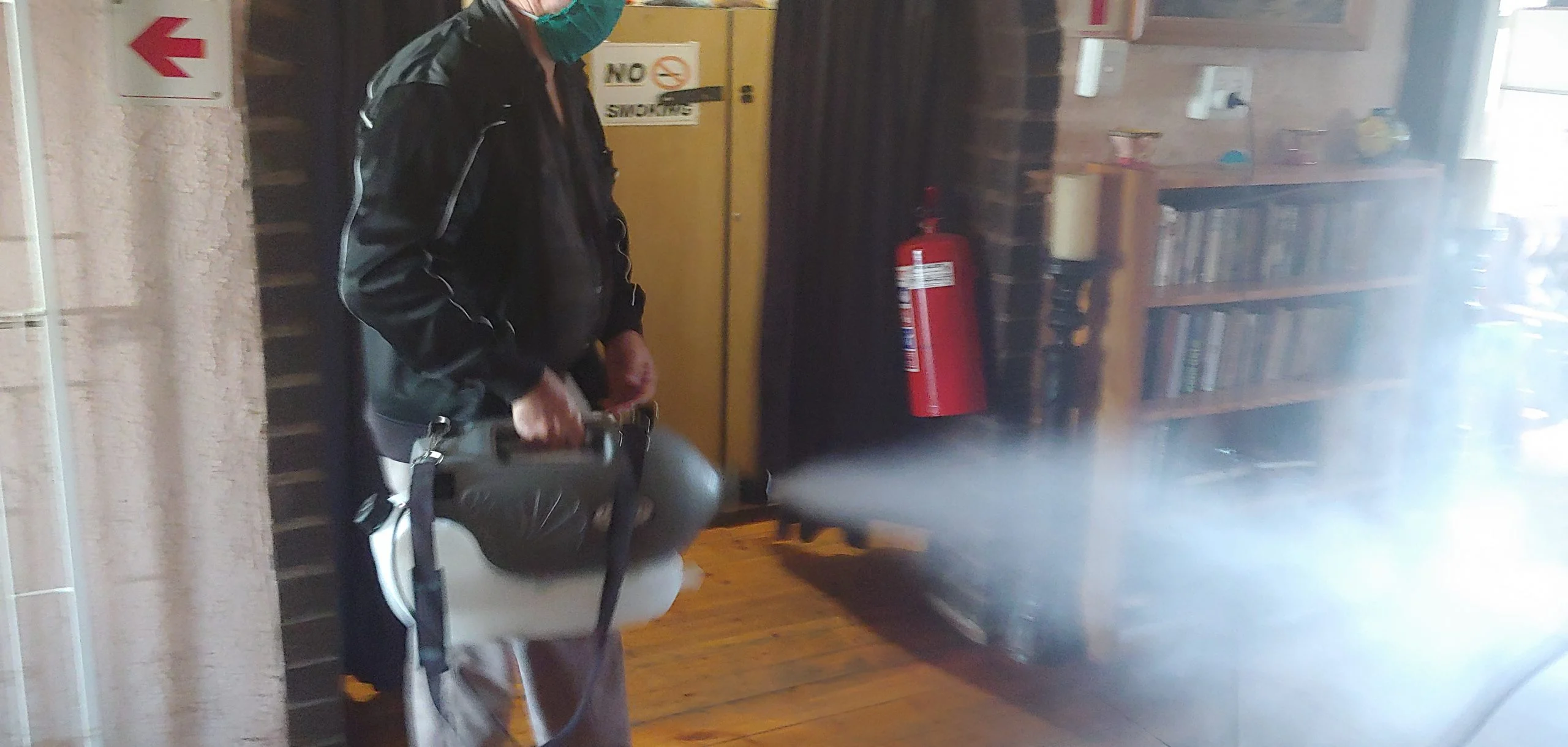
Whether it’s your home, office, shop, factory, school, clinic, vehicle, or taxi, every surface, every corner, and even the air itself can be fully sanitised in a single quick treatment using our professional ULV cold-fogging technology.

What exactly is ULV fogging?

ULV stands for Ultra-Low Volume. Our specialised electric foggers convert a water-based, food-safe disinfectant into an ultra-fine dry mist (5–30 micron droplets – smaller than most viruses). This mist:

  • Behaves like a gas and penetrates every crack, crevice, drawer, and fold
  • Reaches under furniture, behind appliances, inside air-con vents, and into soft furnishings
  • Coats all touch-points: door handles, light switches, keyboards, desks, steering wheels, and seats
  • Floats in the air for several minutes, disinfecting the atmosphere itself before settling evenly on every surface

The result? 360° coverage with no wiping, no missed spots, and no residue.

Our sanitising solution – safe for people, deadly on germs

We only use a premium, broad-spectrum, hydrogen-peroxide–based disinfectant that is trusted by hospitals, ambulances, and food-processing plants worldwide.

You and your family/pets/staff can benefit from a product that is:

  • Completely non-toxic (safer than many household cleaners)
  • Non-irritating to skin, eyes, and lungs
  • Alcohol-free and bleach-free
  • Non-corrosive – safe on electronics, fabrics, leather, and varnished wood
  • Non-staining – no bleaching of carpets or clothing
  • Leaves a fresh, clean odour (no chemical smell)
  • 100 % biodegradable and environmentally friendly
  • Kills 99.99 % of bacteria, viruses (including coronaviruses), fungi, and mould spores
  • Proven 6–8 hour residual effect on surfaces

Officially registered and approved by:

  • SABS (South Africa)
  • APVMA (Australia)
  • EPA (United States)
  • DAFF / NRCS (South Africa)

How the treatment works

  1. A technician in full PPE arrives at the agreed time.
  2. We ask occupants and pets to step outside for 15–25 minutes (only while fogging is active).
  3. We fog every room, corridor, bathroom, kitchen, and vehicle interior.
  4. The mist dries naturally in 10–30 minutes.
  5. You can re-enter immediately – no waiting, no wiping, no ventilation needed.

Unbelievably affordable pricing

You might expect this level of professional disinfection to cost thousands. Think again!

Special extended offer:
Only R2.95 per square metre (less than R3!) for the entire premises – no minimum charge, no hidden fees.

Examples:

  • Average 3-bedroom house (120–150 m²) → R360 – R450
  • Standard office (200 m²) → R590
  • Taxi or private car → from R250
  • Restaurant or retail shop → priced by floor area, still under R3/m²

This is the same technology used in hospitals and quarantine facilities, now available to every South African home and business at a fraction of the usual price.

Don’t wait for the next wave. One quick treatment gives you weeks of protection and total confidence that your space is genuinely clean and safe.

Call or WhatsApp SWAT now on [insert number] to book your slot. Same-day and weekend appointments available.

Because your health shouldn’t cost the earth.

Fishmoths
FishMoth
Fishmoth

Fishmoths (Silverfish) – Lepisma saccharina

Commonly called “fishmoths” in South Africa and “silverfish” worldwide because of their shiny, metallic-silver or pearl-grey colour and the distinctive fish-like, wiggling movement they make when they run.

Appearance and biology

  • Teardrop-shaped, flattened body that tapers from head to tail
  • Length: 12–19 mm (adults)
  • Covered in tiny silvery scales that rub off easily (if you squash one, you’ll see the silver scales stick to your finger)
  • Three long, tail-like appendages (cerci) at the rear and two long antennae at the front
  • Six legs and very fast, erratic movement – they can run up to 1 metre per second
  • No wings at any life stage
  • Extremely long-lived for an insect: adults can survive 3–8 years and can go without food for up to a year

Silverfish prefer dark, damp, warm places (25–30 °C and 75–95 % humidity). They are strictly nocturnal and shy away from light, which is why you usually only spot them when you suddenly switch on a light or move a box that hasn’t been touched in months.

Where they hide in your home

  • Behind skirting boards, architraves, and cornices
  • Inside and behind kitchen and bathroom cupboards
  • Under sinks and around leaking pipes
  • Behind picture frames, mirrors, and wall hangings
  • Inside bookcases, between pages of seldom-used books, and in cardboard boxes
  • Under carpets and rugs (especially in humid rooms)
  • In linen cupboards, folded towels, bedding, and clothing storage
  • Inside wall voids, roof spaces, and sub-floor areas

They often enter homes in second-hand furniture, old books, cardboard boxes, or even new gypsum board and wallpaper paste (which contains starch they love).

What they eat – and the damage they cause

Silverfish have chewing mouthparts and a digestive enzyme that breaks down starch and cellulose. They feed on:

  • Paper, books, photographs, and wallpaper (especially the starch-based paste behind wallpaper)
  • Natural fibres: cotton, linen, silk, wool, leather, and rayon
  • Carpets, rugs, tapestries, and curtains made from natural materials
  • Clothing – particularly suits, jerseys, and items stored long-term
  • Food spillages: sugar, flour, pasta, dead insects, and even their own cast-off skins
  • Glue in book bindings, cardboard, and packaging

Damage is usually irregular holes, surface grazing, and yellow staining. In heavy infestations they can completely destroy the nap of wool carpets, eat large sections out of silk ties or suits left in storage, ruin priceless books and documents, and turn stored linen into lace.

Signs of a fishmoth infestation

  • Small irregular holes or scrape marks on clothing, paper, or carpet
  • Yellowish stains on fabric or paper
  • Tiny black pepper-like droppings
  • Cast-off silvery skins in cupboards or behind furniture
  • Seeing the insects themselves darting for cover when disturbed

Why they are difficult to get rid of

  • They reproduce slowly (females lay only 1–3 eggs per day, up to 100 in a lifetime), but because adults live for years the population builds up steadily
  • Eggs are tiny, white, and laid singly in cracks and crevices – almost impossible to find
  • They avoid baits that work on cockroaches and ants
  • They can survive extreme conditions and starvation

If you’re finding mysterious holes in your best suits, books with pages that look grazed, or little silver insects wriggling away when you open a cupboard, you have a fishmoth problem that won’t go away on its own.

Call SWAT Exterminators for a treatment programme that reaches the hidden places where fishmoths live and breed. Protect your wardrobe, your library, and your carpets – don’t let these ancient little scavengers eat away at your valuables.